
What's Inside
We analyzed over 30,000 messages that friends and family left on TributeWell memorial and tribute pages in October 2026. People mention someone's laugh four times more often than anything they achieved. They thank the person nine times more often than they express regret. And nearly a third of messages aren't written about the person at all. They're written to them.
1. People talk to the person, not about them
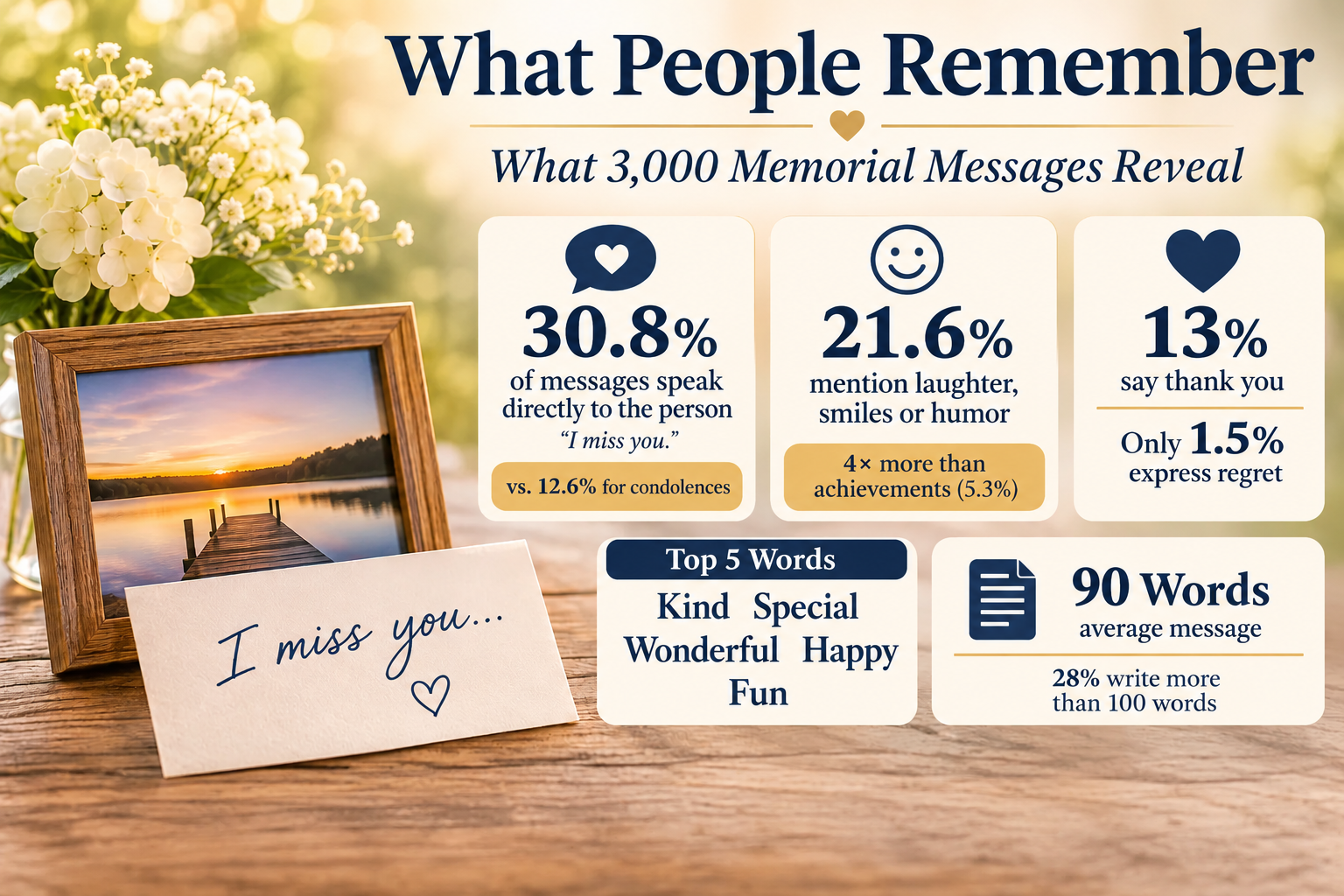
30.8% of messages speak directly to the person ("I miss you," "you taught me," "rest easy"), compared with 12.6% that offer condolences to the family ("sorry for your loss," "thinking of your family"). That's almost 2.5 to 1.
A memorial page isn't treated like a sympathy card. It's treated like a place where the person can still be reached. People write the way they'd talk if they had one more phone call.
2. Laughter beats achievements 4 to 1
21.6% of messages mention laughter, smiles, jokes or humor. Only 5.3% mention a career, award, promotion or accomplishment.
Obituaries tend to list jobs, degrees and honors. The people who knew someone remember something else: how they made the room feel. Kindness (16.7%) also comes up three times as often as career.
3. The words people use most
These are the words most often used to describe the person, by share of messages that contain them:
- Kind (8.5%)
- Special (5.9%)
- Wonderful (5.6%)
- Happy (5.1%)
- Fun (5.0%)
- Amazing (4.2%)
- Loving (4.1%)
- Strong (3.1%)
- Caring (2.8%)
- Positive (2.7%)
"Beautiful" and "light" also appear often (8.5% and 5.0%), but people use them for photos and services too ("a beautiful tribute," "light a candle"), so we left them off the ranking.
What's missing is just as telling. "Smart" and "hardworking" barely register: neither reaches 1% of messages.
4. Gratitude outweighs regret 9 to 1
13% of messages say thank you. Only 1.5% express regret: "I never told you," "I wish I had," "I should have."
We expected more regret. Instead, most people use the space to say what they're grateful for. That's a strong argument for saying it sooner, while the person can still read it. That is the idea behind a living tribute.
5. These aren't one-line "RIP" posts
The average message is 90 words. More than a quarter (28%) run past 100 words. Given a quiet place to write, people tell stories.
What this means if you're writing a tribute
- Write to them. "You" is more natural than "he" or "she," and it's what most people do.
- Lead with a moment, not a résumé. One time they made you laugh says more than a list of accomplishments.
- Say thank you for something specific. It's the most common thing people want to say.
- Don't wait. If there's someone you'd write this about, they can read it now. Here's what to write in a living tribute.
How we did this
We looked at every written message on TributeWell tribute pages in October 2026: over 30,000 messages across hundreds of memorial and living tribute pages. A script counted how many messages contained words and phrases in each theme (for example, "laugh," "smile," "funny" and "joke" for laughter). We counted messages, not individual words, so one message mentioning laughter three times counts once. No one read individual messages for this analysis, and no names or message text were collected. The data includes living tributes, where speaking directly to the person is expected.
Frequently asked questions
What do people write most on memorial pages?
In over 30,000 TributeWell messages, the most common themes were speaking directly to the person (30.8%), laughter and humor (21.6%), faith (18.9%) and kindness (16.7%). Achievements appeared in only 5.3% of messages.
What words are used most to describe someone who died?
Kind, special, wonderful, happy and fun were the five most common descriptive words in TributeWell memorial messages through November 2026. Smart and hardworking each appeared in fewer than 1% of messages.
Do people express regret in memorial messages?
Rarely. Only 1.5% of messages expressed regret, while 13% said thank you. People use memorial pages mainly to express gratitude and share memories.
Gather Everyone's Messages in One Place
Instead of collecting notes one by one, share a single link and let everyone who loves them add their message, photo, or video. TributeWell brings it all together into one page you can share today — and keep forever.
Create a Living TributeFree trial • No credit card required • Guests never need an account
Messages for Specific Occasions
For someone in hospice or seriously ill
Keep it warm and specific, and don't be afraid to say the simple things directly. You don't have to reference what's happening — a message that celebrates who they are is often the greatest comfort.
For a milestone birthday
For more on the bigger picture, see our guides to living tribute ideas and how to honor someone while they're still alive.
Frequently Asked Questions
What do you write in a living tribute?
Write the things people usually save for a eulogy: a specific memory only you share, what the person taught you, a moment that changed you, and a plain statement of what they mean to you. Tie your words to a real moment rather than general praise — one true story lands harder than a page of adjectives.
What do you say to someone in a living tribute during hospice?
Keep it warm and specific, and don't be afraid to say the simple things directly: what you're grateful for, a memory that makes you smile, and that you love them. You don't need to reference what's happening — a message that celebrates who they are is often the greatest comfort.
How long should a living tribute message be?
There's no right length. A few heartfelt sentences tied to one specific memory is plenty and often more moving than several paragraphs. Say the true thing, name the moment, and stop there.